English
 Azərbaycanca
  Русский
How Is Colored Paper Made?
How Is Colored Paper Made?
Colored paper is widely used in packaging, printing, advertising, invitations, business cards, premium boxes, and many other design products. Although it may seem to differ from ordinary white paper only by its color, the production of high-quality colored paper involves several technological stages.
The production method depends on the type of paper, the raw materials used, the required color, the surface effect, and the final application.
1. Preparation of Raw Materials
The first stage of production begins with cellulose fibers, which are mainly obtained from wood.
The cellulose is mixed with water to create a liquid paper pulp. Depending on the type of paper being produced, various additives may also be included in this mixture.
For example:
-
color pigments and dyes;
-
strengthening additives;
-
substances that improve surface smoothness;
-
additives that increase resistance to moisture and water;
-
components that create special textures and visual effects.
2. How Is Color Added to Paper?
There are mainly two methods used to produce colored paper.
Mass-Colored Paper
One of the most common methods used for premium design papers is coloring the entire paper mass.
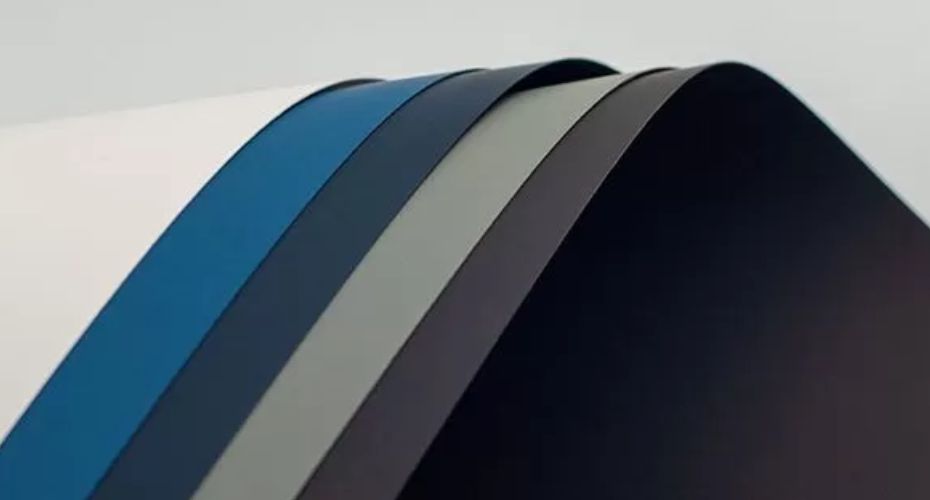
In this process, coloring agents are added while the cellulose is still in liquid form. As a result, the color is distributed throughout the entire thickness of the paper, not only on the surface.
When the paper is cut, its edges remain the same color.
This is especially important for:
premium packaging, invitations, business cards, book covers, perfume boxes, gift boxes, and other high-end products.
Surface-Colored Paper
In another method, white or light-colored paper is produced first, and then dye or a special coating is applied to its surface.
This method makes it possible to create many decorative effects.
For example:
-
metallic effect;
-
pearlescent shine;
-
matte surface;
-
glossy surface;
-
special texture;
-
decorative coatings.
With this type of paper, the surface color and the inner color of the paper may be different.
3. Formation of the Paper Sheet
The prepared colored cellulose mixture is transferred to a special mesh section of the paper-making machine.
At this stage, most of the water is removed from the mixture, and the cellulose fibers begin to bond together, forming a thin paper sheet.
This process directly affects the future thickness, structure, and surface properties of the paper.
4. Pressing
The newly formed paper sheet still contains a significant amount of water.
For this reason, it passes through special press rollers. Pressing removes excess water and makes the paper denser and stronger.
This process also helps create a more uniform thickness and surface.
5. Drying
The paper then passes through heated drying cylinders.
At this stage, the remaining moisture is largely removed from the paper.
Correct temperature and moisture control are very important. If the drying process is not properly controlled, the paper may warp or change its shape.
6. Surface Finishing
After drying, the paper may undergo additional finishing processes depending on the required product.
For example, the paper can pass through special rollers to obtain a smoother surface. This process is called calendering.
Other types of paper are intentionally produced with a textured surface.
As a result, different finishes can be created:
smooth, rough, textured, matte, glossy, silky, and other decorative surfaces.
7. Special-Effect Colored Papers
Modern design papers are not limited to simple colors.
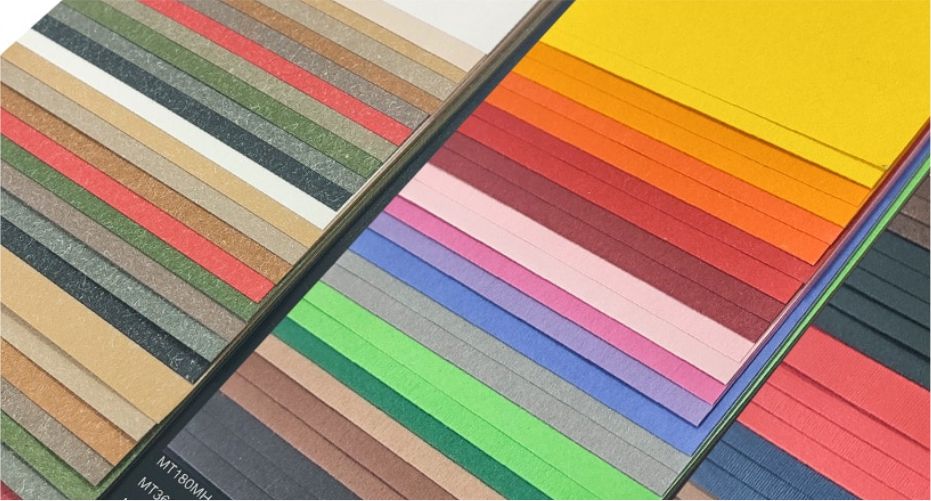
Manufacturers can create special visual effects by using various pigments, fibers, and coatings.
Examples include:
-
gold and silver effects;
-
metallic colors;
-
pearlescent finishes;
-
shimmering surfaces;
-
natural fiber appearance;
-
marble effects;
-
soft or velvet-like surfaces;
-
embossed and textured finishes.
These types of paper are mainly used for premium products.
8. What Does Paper Grammage Mean?
One of the most important characteristics when choosing colored paper is grammage.
Grammage indicates the weight of one square meter of paper and is expressed in g/m².
For example:
120 g/m² – suitable for thinner paper and interior printing applications;
200–250 g/m² – suitable for invitations, menus, cards, and various design products;
300–350 g/m² – suitable for business cards, premium packaging, and boxes;
higher grammages can be used for special packaging and structural applications.
It is important to note that paper thickness depends not only on grammage but also on fiber structure and production technology.
9. Quality Control
At the final stage of production, colored paper goes through various quality checks.
The main characteristics that are tested include:
-
color consistency;
-
grammage;
-
thickness;
-
surface smoothness;
-
moisture level;
-
strength;
-
color durability;
-
print compatibility.
For large print runs, it is especially important that the same color remains as consistent as possible from one production batch to another.
What Is the Advantage of Mass-Colored Paper?
One of the main advantages of mass-colored design paper is that it retains its color even after cutting.
For example, when a 300 g/m² black mass-colored paper is cut, no white line appears along the edges.
This characteristic gives premium packaging and high-quality printed products a more refined and professional appearance.
Where Is Colored Paper Used?
Colored and design papers are used in a wide range of applications:
-
premium boxes;
-
perfume packaging;
-
chocolate and food packaging;
-
wine and beverage boxes;
-
business cards;
-
invitations;
-
certificates;
-
menus;
-
book and catalogue covers;
-
paper bags;
-
labels;
-
advertising and decorative products.
Choosing the right paper can significantly influence not only the visual appearance of the final product but also its tactile feel and overall premium impression.
What Should You Consider When Choosing Colored Paper?
When selecting colored paper, color alone is not enough.
It is also important to consider the paper’s grammage, thickness, texture, compatibility with printing technologies, lamination, foil stamping, UV varnishing, die cutting, and other finishing processes.
For example, standard CMYK printing may not provide the desired result on some dark-colored papers. In such cases, white toner, white ink, hot foil stamping, screen printing, and other specialized printing technologies may be used.
Conclusion
The production of colored paper is much more than simply coloring white paper. From cellulose preparation to coloring, sheet formation, pressing, drying, and surface finishing, every stage influences the quality of the final product.
This is why two papers that appear to have the same color may differ significantly in quality, texture, print compatibility, and durability.
In professional printing and packaging projects, choosing the right colored or design paper can completely transform the appearance and perceived value of the finished product.